
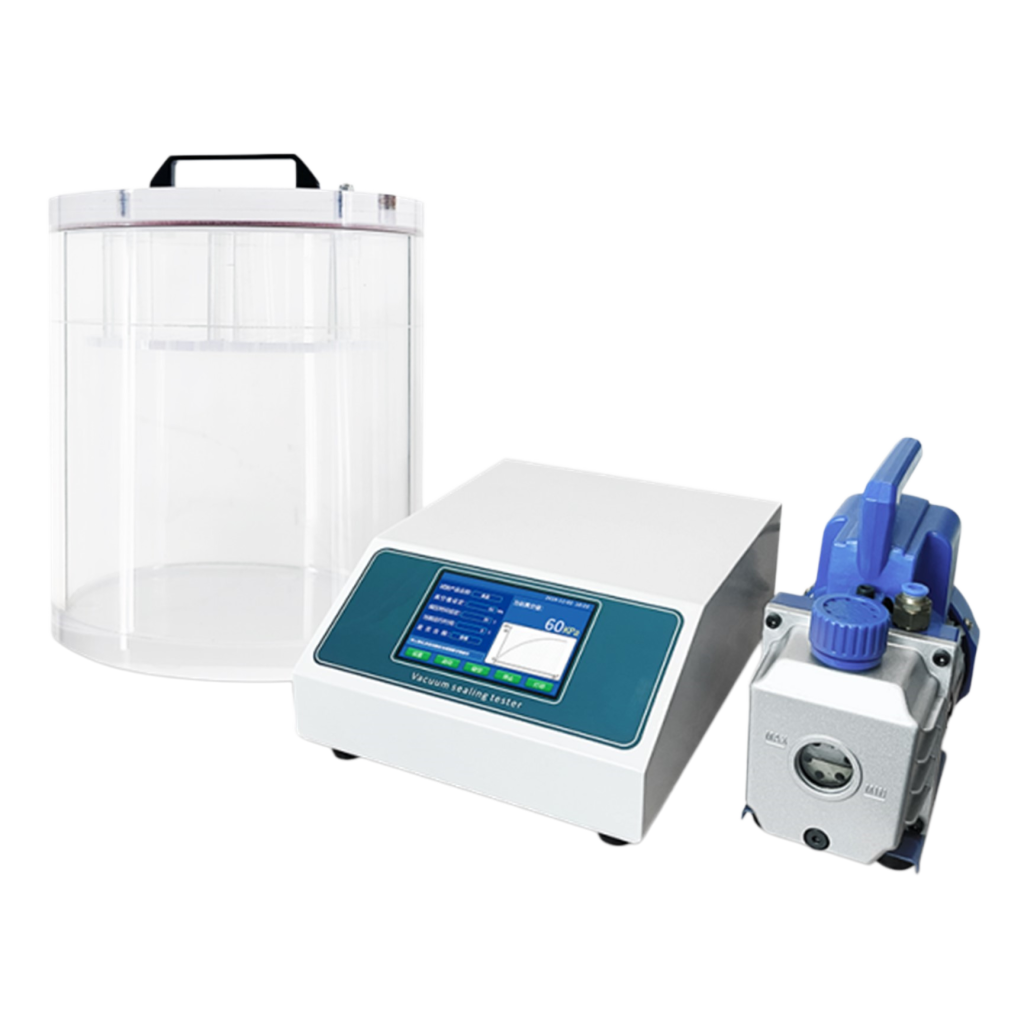
The MF-300D is a benchtop vacuum leak tester that does one job: proving that a sealed package is actually sealed. A controlled vacuum is drawn around the sample, and the operator judges the result the way ASTM D3078 describes it — bubbles escaping under water, or a package that inflates under vacuum and never recovers its shape.
1. ASTM D3078: What the Method Requires
ASTM D3078 covers gross leaks in flexible packaging that contains a headspace gas. The apparatus requirement is short and strict: a transparent chamber able to withstand about one atmosphere of differential pressure, a vacuum-tight cover, a gauge, and an immersion fluid that does not degrade the package. Sensitivity sits around 1 × 10⁻⁵ atm·cm³/s, and the standard states plainly that small leaks may not be detected, because film creep or the product itself can plug the defect.
The output is a go/no-go judgement with a location, not a leak rate, and the standard deliberately gives no universal vacuum level or hold time. Both must be established for your package and written into your own procedure.
2. Testing Principle
Once the chamber pressure drops below the internal pressure of the package, the differential ΔP = P(atm) − P(chamber) pushes gas out through any open path. The MF-300D builds that differential with a 150 W pump at 2 kPa·L/s, holds it by automatic constant-pressure replenishment, and offers two ways to read the result. Wet: bubbles rising from the leak site — the ASTM D3078 bubble emission test in the literal sense. Dry: inflation under vacuum and failure to recover, the faster option for sachets and printed cartons that must not be wetted.
The same negative-pressure route also covers the underwater bubble method of GB/T 15171-2025, so one unit serves a US and a Chinese test requirement. Where a numerical leak rate is specified under ASTM F2338 or a vacuum decay method, a dedicated decay instrument is the correct complement.
3. Key Features
5-inch touch screen with live vacuum curve
One-touch evacuate, hold and vent
Automatic constant-pressure hold across 0 to −98 kPa
kPa / MPa / Bar / PSI unit switching
Transparent acrylic chamber, Φ270 × 200 mm
500 test records stored on board
4. Technical Specifications
| Parameter | Specification |
| Vacuum setting range | 0 ~ −98 kPa |
| Effective chamber size | Φ270 mm × 200 mm |
| Measuring time / accuracy | ≤ 99,999 s / 1 s |
| Pumping rate | 2 kPa·L/s |
| Vacuum pump power | 150 W |
| Dimensions (main unit) | 300 × 240 × 120 mm |
| Operating voltage | AC 220 V, 50 Hz |
| Total weight | 20 kg |
5. Applications
Glass bottles, vials, plastic solid bottles, blister packs, aluminum-plastic sachets, syringes, pipettes, vacuum bags, cans, milk-powder bags, foil bags, eye-drop bottles, medical device packaging, liquid bags, jelly cups, caps and cosmetic bottles — used by pharmaceutical manufacturers, packaging producers, drug inspection centres, medical device and food companies for routine seal-integrity inspection.
6. FAQ
Does ASTM D3078 need different equipment from GB/T 15171?
No, for the bubble route. Both call for a transparent vacuum chamber, a stable hold, an immersion fluid and a controlled release — the same four conditions the MF-300D provides.
What vacuum level should I set?
There is no universal value. Start at −30 to −50 kPa for flexible pouches and −60 to −90 kPa for rigid containers, then confirm by validation against your own acceptance criteria.
Will it detect micro leaks?
No — ASTM D3078 is a gross-leak method and states that small leaks may not be detected. For micro leaks, pair the unit with vacuum decay testing.
7. Ordering
Three details settle the configuration: the largest sample size, whether it will be tested wet, dry or both, and the destination voltage. Send a drawing or a photo with dimensions, and chamber fit, fixture and parameter set are confirmed before the order rather than after it.
Contact Information
Email:maomao@dansentech.com
Inquiries about product brochures, quotations and cooperation are welcome.
Leave a Reply