
Written for beverage, food, dairy and household-care packaging manufacturers, this article focuses on the test methods for closure sealing performance themselves, explaining acceptance conditions, instrument configuration and quality-control essentials.
1. Introduction
A closure is the only physical barrier between a bottled product and the outside world. In carbonated beverages, internal pressure rises markedly under heat, vibration or direct sunlight; once the seal fails, the consequences range from leakage and bulging to violent spray on opening. For non-carbonated drinks, dairy products and condiments, a poor seal means oxidation, microbial ingress and a shortened shelf life. Sealing performance is therefore an unavoidable item in incoming inspection, type testing and release inspection of closures. What this solution addresses is how to make the test accurate, reproducible and traceable.
2. Test Methods and Acceptance Conditions
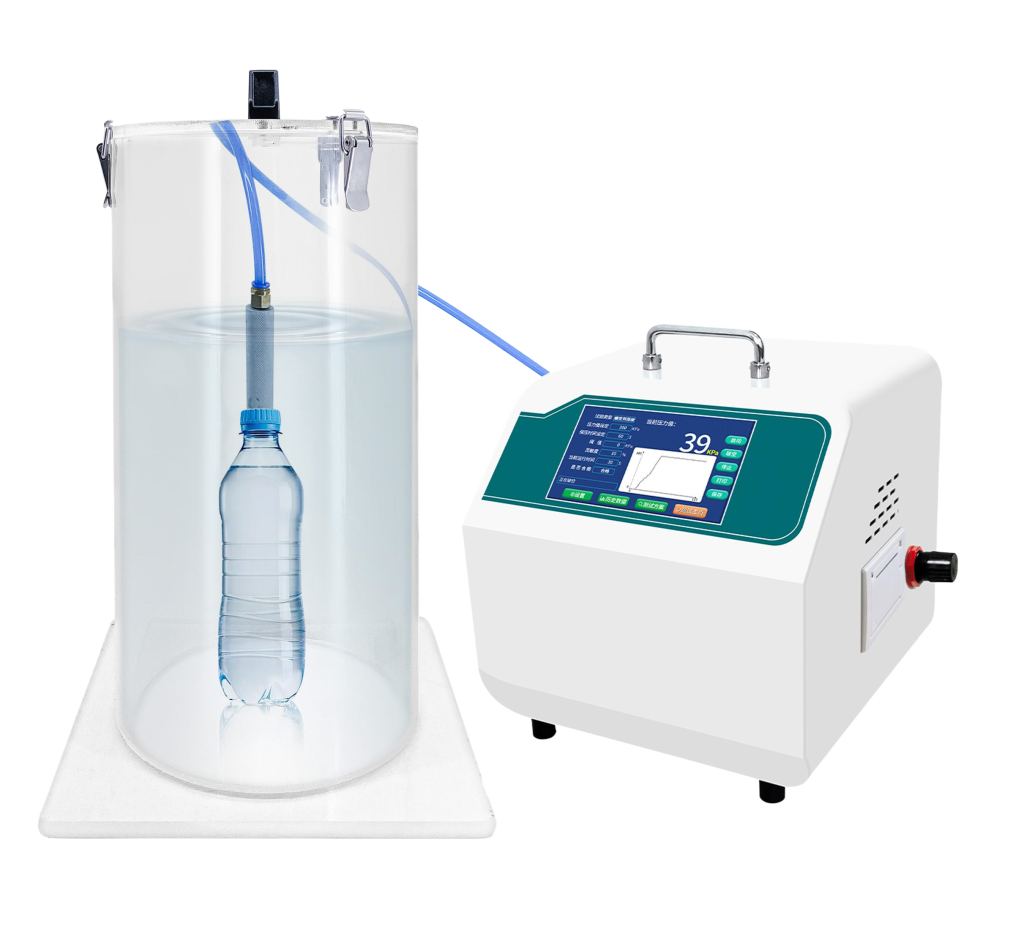
The current national standard specifies a two-stage positive-pressure hold test with underwater observation for plastic tamper-evident closures, and differentiates test conditions by closure type. A non-carbonated closure is first capped at the rated torque that satisfies the capping requirement, then pressurized to 200 kPa through a closure puncture fixture, held underwater for 1 minute and observed for leakage; the pressure is subsequently raised to 350 kPa, held for another minute, and the closure is checked for loosening or popping off.
A carbonated closure is capped under the same requirement, but specimen preparation differs—the tamper-evident ring must be removed first. The closure is then pressurized in the same manner to 690 kPa, held underwater for 1 minute and observed for leakage; the pressure is raised to 1 207 kPa, held for 1 minute, and the closure is checked for loosening or popping off.
The two pressure stages serve different purposes: the lower pressure tests sealing capability—whether gas can be effectively retained inside the bottle—while the higher pressure tests resistance to pressure-induced cap release—whether the closure loosens or pops off under pressure impact. Both stages require a hold of 1 minute, and a shorter hold leads directly to missed detections. The pressure levels reflect real in-bottle conditions: carbonated products contain dissolved CO₂ and therefore hold noticeably higher internal pressure, so their acceptance pressures are correspondingly higher. Removing the tamper-evident ring before testing a carbonated closure prevents any residual structure from interfering with the stress state of the cap, keeping the assessment focused on the sealing fit between closure and bottle finish.
3. Test Solution and Instrument Selection
The positive-pressure solution centers on a sealing tester plus a dedicated closure puncture fixture. The fixture must mate reliably with the bottle finish and pressurize through the closure, while keeping the test circuit itself leak-tight—otherwise a fixture leak will be misread as a closure leak. Three selection criteria matter most: whether the pressure range covers the 1 207 kPa release test, whether hold-time accuracy reaches 1 second, and whether the transparent test tank accommodates a whole bottle while allowing the operator to clearly watch for bubbles and cap movement.
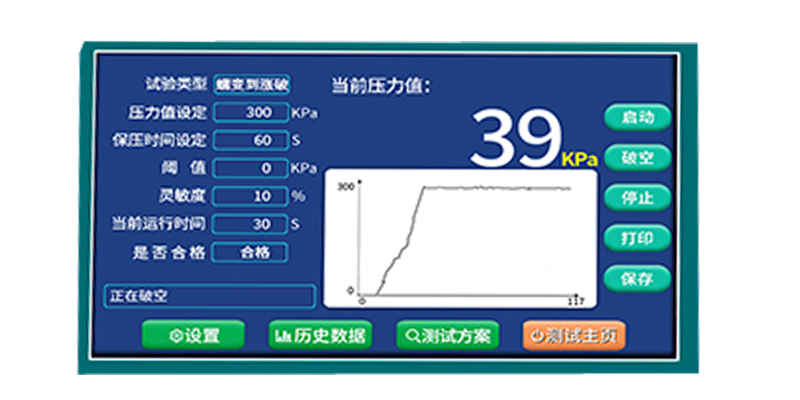
Modern touch-screen models simplify operation considerably: one touch starts the test, and it ends and releases pressure automatically, so the operator only has to watch for bubbles and cap movement underwater. Parameter libraries can store preset test conditions for different closure types, avoiding human error from manual pressure and time settings; the pressure curve is displayed in real time, and pressure, time, curve and operator can be archived together, making every test fully traceable to the production batch record. Where the carbonated-closure release test must be covered, a higher-range model with a pressure-rated fixture should be selected, and the actual pressure capability of the air supply and tubing verified at the same time.
4. Quality Control Essentials
Four variables must be held constant to keep results under control. First, consistent capping conditions: all specimens should be capped on the same machine at the rated torque that satisfies the capping requirement, with the machine’s output torque checked periodically, because torque variation is itself a variable in sealing results. Second, correct specimen preparation: remove the tamper-evident ring on carbonated closures as specified, and keep the puncture point and sealing surface clean and free of oil or residue, so that foreign matter neither creates false leaks nor masks real defects. Third, a stable environment and medium: keep air-supply pressure and water temperature steady and follow the specified pressurization rate and hold time exactly, since timing error directly undermines comparability. Fourth, traceable records: link test pressure, hold time, curve, operator and sample batch number to the production batch record to satisfy quality-system requirements for data integrity.
5. Frequently Asked Questions
If pressure will not build up, or drops during the hold, check the fixture gasket, tubing connections and air-supply pressure first to confirm whether the test circuit itself leaks, then examine the closure-to-finish fit for defects. Poor repeatability within a batch is usually caused by inconsistent capping torque, water-temperature fluctuation or subjective bubble reading; standardize parameters and observation position, define a clear reading criterion, and keep the pressure curves as supporting evidence. If a closure loosens even at the lower pressure stage, it usually indicates insufficient capping torque or an abnormal dimensional fit between finish and closure, rather than an instrument problem. If the 1 207 kPa stage exceeds the instrument range, select a higher-range model with a pressure-rated fixture and verify the actual output capability of the air supply and tubing, rather than “working around” it by lowering the test pressure. Note also that sealing performance testing is destructive: once punctured and pressurized, a specimen should not be reused for other test items.
6. Conclusion
The value of closure sealing tests lies not in producing a single data point, but in building a control system with clear limits, reliable methods and traceable data. Capping at the rated torque, setting pressures by closure type, strictly following hold times, and retaining complete pressure curves and records—these are the four pillars of a solid testing practice. Based on your product structures, closure types and line conditions, we can provide an integrated configuration proposal covering fixture customization, parameter presets and data management.
7. Special Testing Requirements
The standard sealing performance test covers acceptance scenarios for conventional closures and bottle finishes, but real production often involves more complex cases—non-standard pressure conditions, unusual closure designs or special bottle finishes, purpose-built puncture fixtures, extreme-pressure tests beyond the available range, and durability assessments requiring extended holds or repeated pressure cycles. Such needs cannot be handled simply by applying general-purpose equipment and fixed parameters; the test scheme has to be designed around the actual product structure and service conditions.
If your company has special testing requirements, please contact our company engineers directly. Working from your product structures, closure types, line conditions and inspection objectives, we will help confirm test pressures and hold times, assess the compatibility of fixtures and instrument ranges, and propose a practical test scheme and equipment configuration.

Leave a Reply