
Pouch Burst Strength and Three-Side Seal Strength Testing
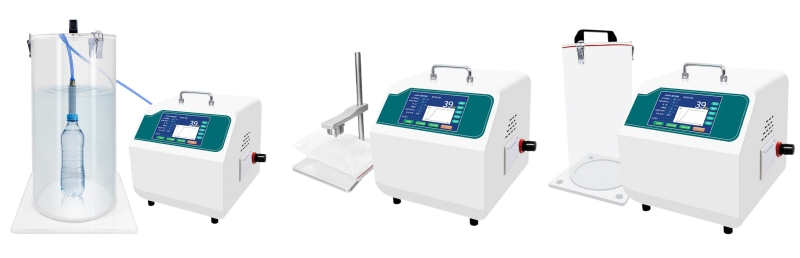
1. Why One Pouch Needs Two Tests
A flexible pouch can peel at the seal interface, split cohesively inside the seal, tear at a corner, or rupture in the base film millimetres away from the seal — each mechanism pointing to a different cause on the sealing line.
A burst test reports the internal pressure the whole package survives; a three-side seal test reports the pressure the seal itself carries when the open edge is clamped and the film can no longer share the load. A pouch that bursts at 68 kPa can still ship with a corner seal that peels at 22 kPa.
2. Standards and Test Principle
The MF-700D works on the positive-pressure principle: controlled gas enters through a piercing nozzle or a clamped open mouth while a pressure transducer records internal pressure against time. Burst mode inflates at a constant rate until rupture and freezes the peak. Creep mode ramps to 70–90 % of the burst pressure and judges stability over 30–300 s.
ASTM F2054 covers burst testing inside restraining plates, where the film cannot balloon and the seal must carry the load. ASTM F1140 covers unrestrained packages, reproducing altitude change or internal gas generation but letting film elongation mask a weak seal.ASTM F88 measures peel strength in N/15 mm and complements rather than replaces these methods; for sterile barrier systems ISO 11607-1/-2 turn the same data into validation evidence, and GB/T 10004 is the reference frame for food packaging.
3. Procedure

Prepare. Condition specimens at 23 ± 2 °C and 50 ± 5 % RH for at least four hours, use five parallels per batch, and reject folds, pinholes, delamination or seal contamination.Mount. For finished pouches, pierce the wall and press the septum down until the port is leak-tight — a leaking puncture is the most common cause of a falsely low burst value. For three-side bags, clamp the open edge square to the jaws, nozzle inside and nothing touching the inflating area.
Run and record. Keep the inflation rate identical across comparative runs: changing 300 to 500 mL/min alone shifts burst pressure by several percent. Log peak pressure, failure location (seal centre, corner, base film, puncture port) and failure mode (peel, cohesive split, film tear, channel leak). Discard any specimen that fails at the puncture port.
4. Reading the Pressure Curve
The value lies less in the peak number than in the curve shape and the rupture location. A sharp peak with instant drop and failure at the seal centre points to low seal temperature or pressure, or to contamination in the seal zone. Corner failure points to jaw geometry, corner thinning or short dwell. A tear in the base film away from the seal means the film is the limiting element, often from over-sealing. A slow decay with no rupture is a leak path, not a strength failure.
5. From Measurement to Process Control
A burst value matters only when it is tied to a sealing parameter. Step seal temperature in 5 °C increments at fixed dwell and pressure, repeat at three dwell times, then repeat at the two pressures actually used on the line. The resulting curve usually shows a plateau — the window in which the seal is strong, the film is not embrittled and failure stays at the seal. Set control limits inside that plateau, then reduce routine testing to a few burst and creep runs per shift, monitored as a trend.
The MF-700D supports this workflow on one benchtop platform: burst, creep, creep-to-failure and pressure-hold modes; restrained and unrestrained configurations, so a single unit covers ASTM F2054 and ASTM F1140; a piercing nozzle and septum for sealed pouches, a pneumatic clamp for three-side bags; and a live pressure–time curve on screen, so a stabilisation problem is visible during the run.
6. Conclusion
Burst strength and three-side seal strength measure different things, fail in different places and lead to different corrective actions. Read as two views of one property — the pressure-bearing capability of a flexible package — they move a laboratory from inspection to process control. For a test configuration matched to your pouch construction and film structure, send your sample dimensions and target specification to our technical team.

Leave a Reply